






We have already discovered more than 6,000 planets outside of our immediate neighborhood. Yet, finding a moon orbiting one of those distant worlds has proved considerably harder. Astronomers may finally have something close to the real deal, but this particular object stretches the word “moon” almost beyond recognition.
Using the European Southern Observatory’s Very Large Telescope in Chile, researchers detected strong evidence for a moon-like object in the CD-35 2722 system. Further observations are still necessary to confirm the discovery, but it could become the first confidently detected natural satellite outside our solar system. There is still one tiny complication though. This moon is apparently massive.
Calling this thing a moon gets complicated
The system already looks wildly different from ours. CD-35 2722 is a young star with around half the Sun’s mass. Orbiting it is CD-35 2722 B, a brown dwarf with roughly 37 times Jupiter’s mass. Brown dwarfs sit in the murky territory between the largest planets and the smallest stars. The newly detected object then circles that brown dwarf.
Researchers estimate a minimum mass of around 0.9 Jupiter masses and an orbital period of roughly 170 days. Its location in this cosmic hierarchy makes “exosatellite” the safer term for now. There is currently no formally accepted definition of an exomoon, which makes classification especially awkward when the host itself is a brown dwarf.
How astronomers used an old-planet hunting technique to discover it

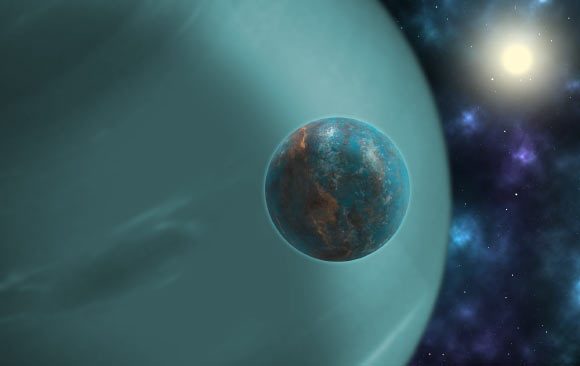
The team detected the object using radial velocity measurements with the CRIRES+ instrument on the VLT. The method watches for tiny gravitational wobbles caused by an unseen orbiting body and famously helped uncover the first exoplanet around a Sun-like star. Here, researchers applied the technique directly to a brown dwarf instead.
Researchers believe that improving instruments should eventually allow them to apply the same technique to smaller satellites and less massive hosts as well. ESO’s upcoming 39-meter Extremely Large Telescope should push that search considerably further. For now, CD-35 2722 has given astronomers an object massive enough to resemble a planet, orbiting something caught between planet and star.