




Meta has a new AI model out, and for once, the biggest headline isn’t about capability; it’s about freedom. Muse Glimmer, sitting around 30 billion parameters, ships with an Apache 2.0 license, meaning the weights on Hugging Face are yours to download, modify, and build on top of, no permission needed. You can simply run it on a graphics card on your local machine, no server farm or online connectivity required.
Meta’s Superintelligence Lab took its larger Muse Spark and essentially had it teach a smaller, leaner version to think as it does. Muse Glimmer accepts both text and image inputs, though it only answers in text. It supports over 100 languages, remembers conversations stretching past 131,000 tokens, and its knowledge stops at January 4, 2026.
How much RAM do you need?
At full precision, Muse Glimmer would eat up 64GB of video memory, way more than most people have lying around, especially in this AI-inflated RAM pricing age. Meta gets around this with quantization, a method that compresses the numbers the model uses so it takes up far less space. That shrinks the language portion to under 20GB.
Two versions are available. K-Quant-Dynamic requires 32GB and barely loses any accuracy (0.2%), while K-Quant-17GB squeezes into 24GB with a slightly bigger, 1% accuracy hit. In real terms, that means you need at least an RTX 5090, RTX 4090, RTX 3090, or a Mac with an Apple Silicon Max chip.
Does it actually feel fast?
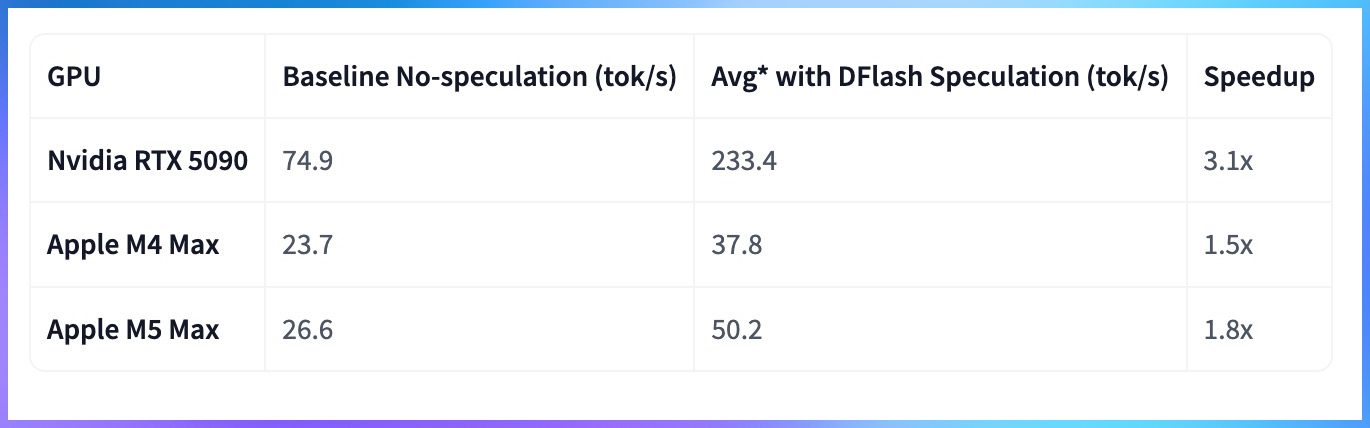
Meta paired the model with an accelerator called DFlash that predicts multiple tokens at once instead of one at a time. On an RTX 5090, that pushes speeds from 74.9 tokens per second to 233.4, over three times faster.
Compared to Google’s Gemma4 and Alibaba’s Qwen3.6, Muse Glimmer leads in planning and multi-step tasks but falls behind when it comes to actually operating a desktop. You can grab it now through Hugging Face or LM Studio if you have the compatible hardware.